Biography
Akbar Behkalam (1944–2025) was a German-Iranian painter whose work unfolds at the intersection of political memory, historical reflection, and painterly transformation. Born in Tabriz, Iran, the capital of the East Azerbaijan province, he studied from 1961 to 1964 at the Tabriz Art School. After completing his military service, he moved to Istanbul, where he continued his studies at the Mimar Sinan University of Fine Arts under the influential painter and poet Bedri Rahmi Eyüboğlu.
Between 1972 and 1974, Behkalam lived and worked in several European cities, including Paris, Frankfurt, Rome, and Berlin. In 1974 he returned to Iran to teach at the Tabriz Art School, but political tensions and increasing repression forced him to leave the country again in 1976. He subsequently settled in Berlin and Brandenburg, where he lived and worked for the rest of his life until his passing in Berlin on February 7, 2025.
Behkalam’s artistic development reflects both his personal biography and the historical upheavals of the late twentieth century. His early paintings addressed political themes directly, engaging with violence, repression, and the complex history of his homeland. One of the most important recurring subjects in his work was the turbulent political history of Iran. In the series Persepolis (1977–1979), Behkalam juxtaposed ancient Persian iconography with stark images of execution squads from the Shah’s regime, creating a powerful dialogue between cultural heritage and contemporary brutality. In the 1980s he created the series Justice in Allah’s Name, a critical response to the religiously legitimized human rights violations carried out under the Islamic Republic.
During the mid-1980s Behkalam also turned his attention to European revolutionary history. Between 1984 and 1986 he conducted extensive research on the German Revolution of 1848, producing several large-scale paintings on the subject. These works were presented in a major solo exhibition at the Staatliche Kunsthalle Berlin in 1986, marking an important moment in his engagement with historical narratives beyond the context of Iran.
Stylistically, Behkalam’s work evolved significantly over time. His early visual language was influenced by New European Realism and combined elements of political figuration with references to Persian miniature painting. Over the decades, however, his painting gradually shifted toward a more open and gestural form of abstraction. In his later works, which can be described as abstract-expressionist, figures often dissolve into movement, color, and dynamic painterly gestures.
A central theme throughout his oeuvre is the depiction of collective movement. Behkalam repeatedly explored the formation, rhythm, and choreography of masses—crowds, demonstrations, historical gatherings—transforming them into complex visual fields of motion and energy. In these works, bodies merge with brushstrokes, and historical memory becomes embedded within painterly structures.
Behkalam exhibited widely across Europe, Asia, and North and South America. In 2009 he received the award of the Tashkent Biennial in Uzbekistan. His work remains a powerful reflection on exile, history, and the capacity of painting to transform political experience into visual form.
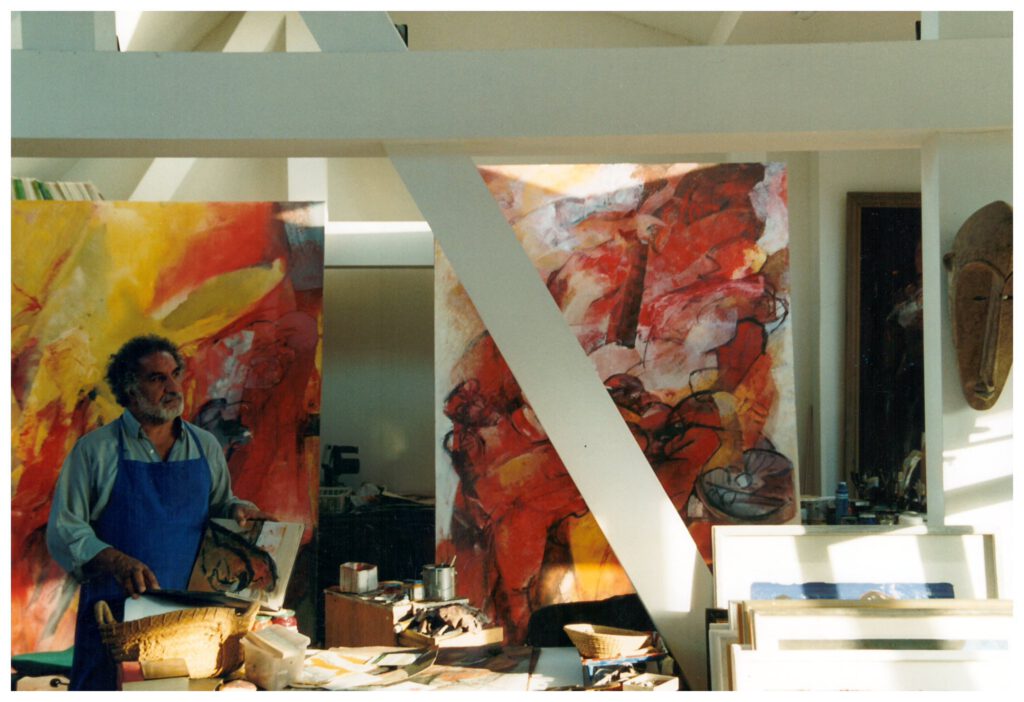
Akbar Behkalam in his Berlin studio. Photo: Kaya Behkalam
Solo Exhibitions
1975 Galerie Seyhun, Teheran, Iran
1979 Einsteinhaus Ulm, Germany
1980 Kulturzentrum Schlachthof, Kassel, Germany
1981 Kunstamt Kreuzberg-Bethanien, Berlin, Germany
1982 Kunstverein Offenbach, Germany
1982 Städtische Galerie Schloss Oberhausen, Germany
1982 Galerie am Eichhof, Kiel, Germany
1983 Galerie Linneborn, Bonn, Germany
1984 Galerie Apex, Göttingen, Germany
1984 Galerie am Chamissoplatz, Berlin, Germany
1985 Galerie Sachs, München, Germany
1985 Galerie Pfeifenberger, Berlin, Germany
1985 Galerie Lineborn, Bonn, Germany
1987 Staatliche Kunsthalle Berlin, Germany
1987 Städtische Galerie Schloss Oberhausen, Germany
1987 Museum Bochum, Germany
1987 Stadtgalerie Saarbrücken, Germany
1987 Galerie fur Junge Kunstler, Mannheim, Germany
1988 Galerie Walther, Düsseldorf, Germany
1988 Überseemuseum, Bremen, Germany
1988 Galerie Linneborn, Bonn, Germany
1988 Workshop I, Rio de Janeiro 2013, Brazil
1989 California State University, Los Angeles, USA
1989 Workshop II, Sao Paulo, Brazil
1989 Visionaten / Sehlieder, München/Berlin, Germany
1990 Phoebe Conley Art Gallery, Fresno, USA
1991 International Gallery on Broadway, Los Angeles, USA
1991 Workshop Ill Joao Pessoa, Paraiba, Brasilien
1992 Galerie Kuhri, Bremen, Germany
1992 Workshop IV, Joao Pessoa, Paraiba/Brasilien
1993 Villa Oppenheim, Berlin, Germany
1995 Galerie Linneborn, Berlin, Germany
1997 Kunstraum Berlin, Germany
2000 Galerie NoTre, Berlin, Germany
2003 International Workshop University of Natal, Brazil
2005 ver.di, Berlin, Germany
2006 Kunsthalle Arnstadt, Germany
2006 Galerie Linneborn, Berlin, Germany
2009 Galerie Linneborn, Berlin, Germany
2013 Galerie arteistanbul, Istanbul, Turkey
2015 National Museum of Fine Arts Baku, Azerbaijan
Group exhibitions
1977 Hommage à Nazim Hikmet, Kunstamt Kreuzberg, Berlin, Germany
1978 Berlin in Bottrop, Kulturwochen Bottrop, Germany
1978 Tu Was – Zur Jugendarbeitslosigkeit, Kunstamt Kreuzberg, Berlin, Germany
1979 Kinder heute, NGBK, Berlin, Germany
1980 Künstler gegen den Krieg, NGBK, Berlin, Germany
1981 30 Jahre BBK, Staatliche Kunsthalle Berlin, Germany
1981 Majakowski Galerie Berlin, Germany
1981 Kreuzberger Künstler, Galerie am Chamissoplatz, Berlin, Germany
1983 1933 – Wege zur Diktatur, Staatliche Kunsthalle Berlin, Germany
1983 300 Jahre danach, Museum des 20. Jahrhunderts, Wien, Austria
1983 Eine Woche im September, Galerie Hilger, Wien, Austria
1984 Rationalisierung, Staatliche Kunsthalle Berlin, Germany
1984 Otto-Nagel Preis 1984, Rathaus Wedding, Berlin, Germany
1984 Ich lebe in Deutschland, Städtisches Kunstmuseum Bonn, Germany
1984 Goethe Institut Brüssel; Galerie Schöneberg Berlin, Germany
1984 Der Krieg trifft jeden ins Herz, Palast der Künste, Minsk, USSR
1985 Fluchtwege, Rathaus Stuttgart, Germany
1986 Das andere Land, Groß Orangerie, Schloß Charlottenburg, Berlin / Museum Bochum / Paulskirche, Frankfurt/Main / Stadtgalerie Saarbrücken; Kultur unterm Turm, Germany
1986 15 Berliner Künstler in Brasilien, Museu de Arte de Sao Paulo / Museu de Arte do Rio Grande do Sul, Porto Alegre, Brazil
1986 Berliner Stadtansichten, Wien, Amsterdam, Nimwegen, London, Istanbul, Paris, Bonn, Berlin
1987 15 Berliner Künstler in Brasilien, Paco Imperial, Rio de Janeiro / Centro de Convencoes, Recife, Brazil
1987-1988 Momentaufnahme (Wanderausstellung durch Brasilien) Joao Pessoa, Paraiba / Museo de Arte Contemporana / Blumenau, Porto Alege, Sao Paulo, Curitiba, Brazil / Caracas, Venezuela
2009 5th Tashkent Biennial, Uzbekistan. Winner of the 1st Prize
2009 lnternational Symposium Schloss Fretzdorf, Brandenburg, Germany
2009 Grand Prix, International Biennale Taschkent, Uzbekistan
2010 Die Berliner Mauer aus Kreuzberger Sicht, Abgeordnetenhaus Berlin, Germany
2010 International workshop University Natale, Brazil
2010 International workshop Selcuk University, Konya, Turkey
2011 International workshop City of Prizren, Kosovo
2011 International workshop City of Bratislava, Slowakya
2012 International workshop Karatay Universitesi, Konya, Turkey
2014 International workshop Bzyegin University, Istanbul, Turkey
2015 International workshop City of Tarsus, Turkey
2015 lnternational Symposium Schloss Fretzdorf, Brandenburg, Germany
2016 Neues aus dem Osten, Rathaus Oberkirch, Germany
2020 Poröse Stadt – Grenzgänge des Urbanen, Kunstraum Kreuzberg/Bethanien Berlin, Germany
2021 Die Reise ins Bild, Graphothek Berlin, Germany
2024 There is no there there, Museum für Moderne Kunst Frankfurt, Germany